
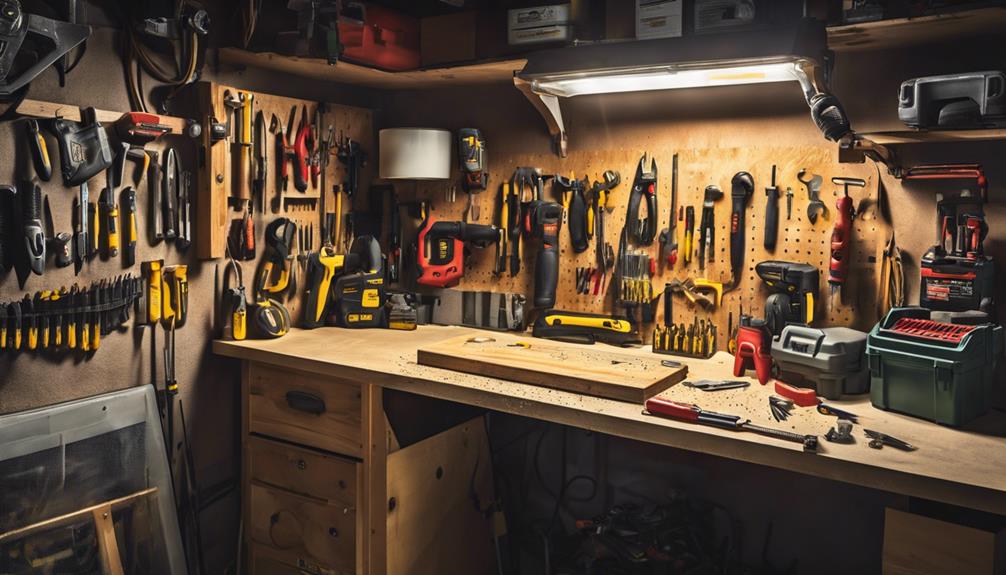
For effective home renovations, homeowners should possess a range of essential tools. Basic hand tools like claw hammers and adjustable wrenches are foundational. Accurate measurements are guaranteed with tape measures, laser levels, and measuring wheels. Cutting tools, including saws and utility knives, offer versatility for various materials. Power drills, especially cordless ones, provide both power and precision for drilling and fastening tasks. Plumbing wrenches and snakes are vital for tackling plumbing issues. Proper safety gear, such as goggles and gloves, along with painting supplies, will round out your toolkit. Mastering these tools can greatly enhance your renovation outcomes. Discover more tips to elevate your projects.
Basic Hand Tools
Every homeowner undertaking a renovation project should have a diverse set of basic hand tools to guarantee efficiency and quality in their work. Among the essential tools for any homeowner are different hammer types and thorough screwdriver sets. These tools not only provide the foundational capabilities needed for various tasks but also empower the homeowner to execute projects with precision and confidence.
Hammers, for example, come in several types, each tailored for specific functions. The claw hammer is possibly the most versatile, featuring a curved claw for removing nails and a flat face for driving them in. For more delicate tasks, a ball-peen hammer offers a rounded end that is perfect for shaping metal without causing damage. Sledgehammers, while less commonly needed, are essential for heavy-duty demolition work, providing the force necessary to break through tougher materials. By selecting the appropriate hammer type, homeowners can make sure they have the right tool for each task, thereby enhancing efficiency and reducing the risk of damage to materials.
Equally important are screwdriver sets, which should include a variety of both Phillips and flathead screwdrivers in multiple sizes. Precision screwdriver sets are particularly beneficial for tasks requiring meticulous attention, such as assembling furniture or working on electrical fixtures. Magnetic tips and ergonomic handles can further enhance control and ease of use, making these tools indispensable in a well-rounded toolkit.
Measuring Instruments
Accurate measurements are essential for any successful home renovation project. Essential tools include tape measures for precise length and width calculations, laser levels for ensuring straight lines and balanced installations, and measuring wheels for larger distances. Each of these instruments offers unique benefits that contribute to the overall efficiency and accuracy of renovation tasks.
Tape Measure Accuracy
Ensuring tape measure accuracy is essential for the success of any renovation project, as even minor discrepancies can lead to significant issues. Accurate measurements are the foundation upon which all subsequent tasks are built, from cutting materials to fitting components. Hence, homeowners must employ effective calibration techniques and adhere to precision maintenance to guarantee their tape measures remain reliable.
Calibration techniques involve periodically checking the tape measure against a known standard, such as a steel ruler or a calibrated scale, to make sure its readings are correct. This can be done by aligning the tape measure with the standard and verifying that the measurements match precisely. If discrepancies are found, adjustments or replacements may be necessary to maintain accuracy.
Precision maintenance is equally important. Keeping the tape measure clean and free from debris, ensuring the blade retracts smoothly, and avoiding drops or impacts that could cause bending or misalignment are all vital practices. Additionally, storing the tape measure in a dry, secure location prevents rust and damage to the internal spring mechanism.
Laser Level Benefits
Frequently employed in both professional and DIY home renovation projects, laser levels offer unparalleled precision and efficiency compared to traditional leveling tools. These devices provide precise alignment, which is crucial in achieving flawless outcomes, whether you're installing cabinetry, tiling, or hanging artwork. Unlike spirit levels, laser levels project a line across a surface, offering a continuous reference point that simplifies the alignment process.
For wall leveling, laser levels prove indispensable. They allow you to project perfectly horizontal or vertical lines, ensuring that wall-mounted fixtures and finishes are impeccably straight. This capability is particularly beneficial when dealing with large surfaces or extended distances where traditional levels might fall short.
Moreover, laser levels come equipped with self-leveling features that automatically correct minor deviations, thereby enhancing accuracy and reducing manual adjustments. This functionality is invaluable for those who desire precision in their renovation projects. By using a laser level, homeowners can achieve a professional finish with minimal effort and time, granting them greater control over the quality and outcome of their work.
In essence, incorporating a laser level into your renovation toolkit not only streamlines the process but also guarantees superior results, making it an essential tool for achieving high standards in home improvement.
Measuring Wheel Uses
While laser levels provide precise alignment within confined spaces, measuring wheels excel in determining accurate distances over larger areas, making them invaluable for outdoor projects and extensive renovation tasks. This versatile tool is particularly useful in landscaping projects and road construction, where measuring long stretches accurately and efficiently is vital.
Measuring wheels come in various models, each designed to meet specific needs. They are simple to use—just roll the wheel along the surface, and the device records the distance traveled. This ease of operation guarantees that homeowners can confidently tackle large-scale tasks without the need for complex setup or calibration.
| Feature | Landscaping Projects | Road Construction |
|---|---|---|
| Distance Accuracy | Essential for garden layouts | Vital for road dimensions |
| Ease of Use | Simple, one-person operation | Streamlines project management |
| Durability | Withstands outdoor conditions | Suitable for rugged terrains |
| Portability | Lightweight and easy to transport | Convenient for large work sites |
Cutting Tools
Cutting tools are essential for any homeowner undertaking renovation projects, providing the precision and efficiency required for various materials and tasks. Among these tools, saw blades and cutting mats stand out due to their versatility and effectiveness. Saw blades are indispensable for cutting through wood, metal, and plastic with accuracy. They come in various types, including circular saw blades, jigsaw blades, and reciprocating saw blades, each designed for specific cutting needs. Selecting the right saw blade ensures clean cuts and enhances the overall quality of the project, making it important to understand the material and the task at hand.
Cutting mats provide a secure and damage-free surface for precise cuts, particularly when working with softer materials such as fabric, paper, and thin plastics. These mats are designed to protect both the work surface and the tool, thereby extending the lifespan of cutting instruments like rotary cutters and utility knives. Self-healing cutting mats, in particular, are a valuable addition to any homeowner's toolkit, as they automatically seal minor cuts and nicks, maintaining a smooth cutting surface over time.
In addition to saw blades and cutting mats, other cutting tools such as utility knives, tin snips, and pipe cutters play significant roles in renovation projects. Utility knives are perfect for trimming and scoring, while tin snips are essential for cutting sheet metal. Pipe cutters, on the other hand, help achieve clean and precise cuts in plumbing work, facilitating easier and more reliable connections.
Power Drills
Power drills are essential tools for homeowners, enabling efficient drilling and fastening in a variety of renovation tasks. They provide the power and precision needed to tackle projects ranging from simple repairs to complex installations. With advancements in technology, today's power drills offer features that enhance both convenience and performance.
One of the most significant innovations in power drills is cordless convenience. Cordless drills eliminate the need for cumbersome power cords, allowing for greater mobility and flexibility. This feature is especially beneficial when working in areas without easy access to electrical outlets or when maneuvering in tight spaces. Modern lithium-ion batteries ensure long-lasting power, reducing the frequency of recharges and providing consistent performance throughout your project.
Another critical feature to take into account is variable speed control. A power drill with this capability allows users to adjust the drill's speed based on the material they are working with. For instance, lower speeds are ideal for driving screws, while higher speeds are more suitable for drilling through dense materials such as hardwood or metal. This adaptability ensures precision and prevents damage to both the tool and the material.
Additionally, ergonomic design plays an important role in selecting a power drill. Look for models with comfortable grips and balanced weight distribution to reduce strain during extended use. Some drills also come with built-in LED lights to illuminate dark workspaces, further enhancing their usability.
Safety Gear
When undertaking renovation projects, appropriate safety gear is indispensable to protect yourself from potential hazards. Key items include protective eyewear and gloves, respirators and masks, and hearing protection essentials. Ensuring you have these tools not only safeguards your well-being but also enhances your efficiency and confidence in completing tasks.
Protective Eyewear and Gloves
Ensuring proper protective eyewear and gloves are worn during renovation projects is essential for preventing injuries and maintaining safety. Adhering to established safety standards is not merely a recommendation but an important requirement. Protective eyewear guards against hazards such as flying debris, dust, and chemical splashes, which can cause severe eye injuries. Homeowners should select eyewear that meets ANSI Z87.1 safety standards, ensuring material durability and reliable protection.
Gloves are another indispensable component of safety gear. They protect hands from cuts, burns, and exposure to harmful substances. When selecting gloves, homeowners should consider the specific requirements of their renovation tasks. For instance, heavy-duty leather gloves provide excellent protection during demolition work, while nitrile gloves are ideal for tasks involving chemicals. Material durability is paramount; gloves should withstand the rigors of the job without compromising comfort or dexterity.
Incorporating high-quality protective eyewear and gloves into your renovation toolkit not only enhances safety but also boosts confidence. By prioritizing these essential items, homeowners can maintain control over their projects, ensuring a secure and efficient renovation process. Investing in proper safety gear is an investment in your well-being and the successful completion of your renovation endeavors.
Respirators and Masks
In the domain of homeowner renovation, respirators and masks are vital safety gear that protect against inhalation of harmful particles, vapors, and fumes. Whether sanding wood, painting, or demolishing walls, exposure to hazardous substances is inevitable. Therefore, selecting the appropriate mask types ensures ideal protection and efficiency in safeguarding respiratory health.
Disposable masks, such as N95 respirators, provide a practical solution for short-term projects, filtering out 95% of airborne particles. However, for more intensive tasks involving volatile organic compounds (VOCs) or chemical fumes, a half-face or full-face respirator with replaceable cartridges is essential. These respirators offer complete protection and can be tailored to specific hazards by choosing the correct cartridges.
Equally important is respirator maintenance. Making sure that reusable respirators are properly cleaned and stored extends their lifespan and maintains their effectiveness. Regularly inspect the respirator for any signs of wear or damage, and replace filters and cartridges as recommended by the manufacturer. Proper fit-testing is also important to ensure a secure seal, preventing any leakage of harmful substances.
Hearing Protection Essentials
Regularly overlooked yet critically important, hearing protection is an essential component of safety gear for any homeowner undertaking renovation projects. Exposure to high-decibel noise from power tools, hammers, and machinery can cause irreversible hearing damage. Therefore, investing in proper hearing protection is paramount.
When considering hearing protection, homeowners have two primary options: earplugs and earmuffs. Earplugs offer a compact, affordable solution and come in various materials and sizes, providing flexibility in earplugs selection. They are particularly advantageous in tight spaces where bulkier protection might be cumbersome. On the other hand, earmuffs provide a higher Noise Reduction Rating (NRR) and are available in numerous earmuff varieties, including electronic models that enhance ambient sounds while blocking harmful noise levels.
| Protection Type | Key Features |
|---|---|
| Foam Earplugs | Disposable, cost-effective, high NRR |
| Silicone Earplugs | Reusable, moldable, comfortable fit |
| Pre-molded Earplugs | Reusable, pre-shaped, easy insertion |
| Standard Earmuffs | Adjustable headband, high NRR |
| Electronic Earmuffs | Amplifies ambient sound, blocks harmful noise |
Painting Supplies
A thorough painting project requires a complete set of high-quality painting supplies to achieve a professional finish. Among the most critical tools are various brush types and paint rollers. Selecting the right brush type is paramount; for intricate details and edges, angled brushes with synthetic bristles provide precision and smooth application. Flat brushes, on the other hand, are ideal for covering large, flat surfaces efficiently. Understanding the appropriate brush type for each task guarantees optimal control and efficiency.
Equally essential are paint rollers, which come in different nap lengths suited to various surfaces. Short-nap rollers, typically ¼-inch to ⅝-inch, are perfect for smooth surfaces like plaster or drywall, delivering a uniform coat without excess texture. Medium nap rollers, around ½-inch, are versatile and handle semi-smooth surfaces well, making them a staple in most painting kits. For rough surfaces such as brick or stucco, long-nap rollers, ¾-inch or longer, are required to reach into the crevices and ensure full coverage. Utilizing the correct roller nap guarantees a consistent and professional finish across diverse surface types.
In addition to brushes and rollers, a high-quality paint tray, painter's tape, and drop cloths are indispensable. Paint trays with sturdy construction and deep wells accommodate different roller sizes and minimize spills. Painter's tape is essential for achieving clean, sharp lines, especially when changing between colors or protecting trim. Drop cloths safeguard floors and furniture from accidental drips and spills, maintaining a clean workspace.
Plumbing Tools
Mastering any plumbing project requires a well-rounded set of essential tools to tackle a variety of tasks efficiently and effectively. For homeowners who seek to maintain control over their renovations, investing in high-quality plumbing tools is indispensable. Among the fundamental items in your toolkit, pipe wrenches and plumbing snakes stand out as particularly vital.
Pipe wrenches are the backbone of any plumbing endeavor. These versatile tools are designed to grip and turn pipes, providing the necessary torque to loosen or tighten connections securely. A standard pipe wrench often features an adjustable jaw, allowing it to accommodate pipes of various diameters. For enhanced control, owning both a small and a large pipe wrench can be advantageous, as it allows for greater maneuverability in tight spaces and increased leverage for stubborn fittings.
Equally important are plumbing snakes, also known as drain augers. These tools are indispensable for clearing clogs that disrupt the flow of water in your plumbing system. Plumbing snakes come in various sizes and designs, but they all serve the same essential purpose: to navigate through pipes and dislodge obstructions. For homeowners, a hand-cranked plumbing snake typically suffices for most residential applications. However, for more challenging blockages, consider investing in an electric plumbing snake, which offers additional power and efficiency.
Frequently Asked Questions
How Do I Budget for a Home Renovation Project?
To effectively budget for a home renovation project, start with a detailed DIY budgeting plan. Break down costs for materials, labor, and permits. Prioritize essential tasks and allocate funds accordingly. Utilize expense tracking tools to monitor spending in real-time and adjust as necessary. This approach guarantees you remain in control of your finances, avoiding overspending and ensuring a successful renovation within your financial limits.
What Are Some Tips for Hiring a Reliable Contractor?
Imagine the satisfaction of seeing your dream home come to life, executed by a dependable contractor. To achieve this, conduct thorough background checks to confirm credibility and experience. Scrutinize project reviews to gauge their reliability and quality of work. Requesting detailed proposals and verifying licenses will further empower you to make informed decisions, securing control over your renovation project from start to finish.
How Can I Ensure My Renovation Stays on Schedule?
To guarantee that your renovation stays on schedule, implement strong project management practices and utilize time tracking tools. Establish clear timelines and milestones, and regularly review progress against these benchmarks. Maintain open communication with your contractor to promptly address any delays. Additionally, employing a project management software can enhance oversight, allowing you to monitor timelines and resources efficiently, ensuring the project adheres to the planned schedule.
What Permits Might I Need for My Renovation?
When undertaking a renovation, it is essential to identify the necessary DIY permits to ensure compliance with local regulations. Permit costs can vary greatly depending on the scope and nature of the project. Typically, structural changes, electrical work, and plumbing modifications require permits. To maintain control over your renovation schedule and budget, consult your local building department to determine specific permit requirements and associated costs before commencing any work.
How Do I Choose the Best Materials for My Renovation?
Did you know that homeowners who prioritize material durability report a 20% increase in long-term satisfaction with their renovations? When selecting materials, consider those proven to withstand wear and tear. Guarantee style consistency by matching new materials with your existing décor. This approach not only enhances aesthetic appeal but also maintains harmony throughout your home, giving you a sense of control over your living space.